
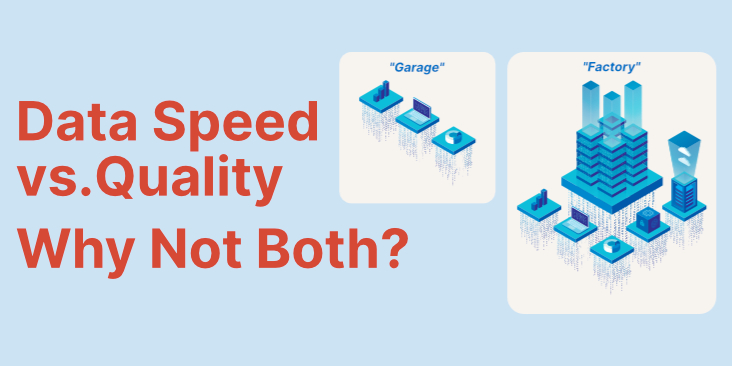
In the rush of 2025's AI frenzy (read the article), businesses face a classic dilemma: data quality versus data speed. The old project management adage rings true: "good, fast, cheap: pick two"; but when it comes to data pipelines and insights, delays mean missed market opportunities.
At CorSource, speed with data isn't a gamble; it's a strategy. By prioritizing rapid execution, you uncover valuable data assets early, then invest in data factory production for reuse and long-term velocity. This bi-modal approach using both a Garage Environment for innovation and a Data Factory for scale balances the tradeoffs.
Change is the only constant: customer needs, market trends, and economic shifts reshape buying cycles daily. Slow data pipelines lead to glacial analysis and decisions, costing revenue as competitors act faster or market windows fade.
High-velocity data delivery enables real-time insights. As an example, consider the challenge with knowing where your company’s product is in its logistics pipeline when it is being handled by 5 different third-party logistics providers also known as 3PLs.
Unifying to the same units such as locations, timestamps, etc. is not out of the box when the 3PLs provide their data in different formats and with different metadata. But unified by one data model allows the data sets and attributes from these 5 different 3PL providers to consolidate to 1 business view enables reliable updates and spotting any issues instantly.
Without speed, even the best AI models starve on stale data. CorSource's bi-modal approach reveals winning assets quickly, informing where to double down for sustained data quality and reuse.
CorSource champions a bi-modal data approach to resolve quality-speed tradeoffs:
Build pipelines, views, APIs, reports, and models like a startup. It ensures fast feedback from users to validate the value of the data. This "garage" environment prioritizes execution over perfection, getting data into the hands of its users quickly for testing utilization and accuracy.
Mode 2: Data Factory (Production Scale)
Proven assets graduate to the factory: where you invest in documentation, data deduplication, performance monitoring, and quality gates. This ensures high availability, consistency, and agility just like a manufacturing production line which is optimized for reuse.
An API facade bridges both modes, providing stability amid changes. Users get uninterrupted access while you evolve pipelines behind the scenes.
An API facade is a simplified, unified interface that hides the complexity of underlying data pipelines, systems, or services behind a stable, user-friendly layer.
Think of it like the dashboard of a car: drivers interact with a clean set of controls and displays without needing to understand the engine, wiring, or transmission underneath. In data architectures, the API facade acts as a “buffer” that translates requests from business users, apps, or AI models into the right formats, while shielding them from backend changes like data source updates or pipeline tweaks. This ensures uninterrupted access, backward compatibility, and easier maintenance. This is a critical element as you evolve your data pipelines for better data quality and speed.
Data initiatives flop due to ignored tradeoffs. Key failures include:
Perfectionism kills speed especially when teams build complex data pipelines that take months, only to pivot on bad assumptions.
Result: abandoned projects and wasted budgets.
Poor inputs cascade failures. Without alerts for data types, value ranges, or vocabularies, pipelines propagate errors to dashboards, reports, and AI.
Result: trust erodes throughout the company and users.
Unifying disparate sources (e.g., five 3PLs with mismatched formats) without standardization leads to confusion since there are no common timestamps or locations to provide a consistent view.
Result: debates about the data analytics eats time.
One-off pipelines aren't scalable. Without documented KPIs and controlled formulas, every team recreates the wheel.
Result: costs increase and time to insights slow.
These pitfalls highlight why data quality must integrate with speed, not fight it.
When data prototypes are proven in Mode 1 as part of a garage environment, they need to be elevated to a Data Factory with these steps:
This creates reusable, extensible pipelines which deliver long-term data speed through reuse.
The garage-factory model flips the script: fast releases test value via usage metrics (daily/weekly cadence, throughput growth). Proven assets get factory hardening for reliability.
Benefits include:
Forward-thinking companies treat data like manufacturing: innovate fast, produce reliably.
A mature Data Factory extends beyond internal users. Robust APIs enable seamless integrations with customers, suppliers, and partners to make your company indispensable.
Unified data models and KPIs foster collaboration, like sharing real-time inventory views with 3PLs. Competitors can't replicate this ecosystem lock-in.
2025 data and AI trends demand balancing data quality, data speed, and data pipelines. Ditch endless tradeoffs with CorSource's bi-modal approach: Garage Environment for validation, Data Factory for endurance.
Build once, reuse forever to turn data into your competitive edge.
Watch the video featuring CorSource’s Joaquin Sufuentes, Director of Professional Services and Head of Data & AI Practice, where he dives into CorSource's bi-modal approach.
Struggling with slow data insights or quality issues?
CorSource’s bi-modal approach uses Garage Environment innovation and Data Factory production to achieve speed, reuse, and trust.
Contact us to discuss your pipelines and accelerate your data velocity today.